
Our History
A Vision Rooted in Community
In the early years of Chicago’s Lithuanian community, a shared question began to take shape: where would a people far from their homeland find a permanent place of rest?
By 1910, Lithuanian societies across Chicago united around a shared vision. To create a cemetery that would preserve heritage, honor tradition, and serve future generations.

“A cemetery of our own—so our people would never be strangers in death as they were in life abroad.” - Common sentiment among early Chicago Lithuanian organizations
Before there were pathways, monuments, or trees, there were hands willing to build a place for future generations.
Founding a Place for the People (1911–1912)
On March 28, 1911, representatives from eleven organizations signed a state-authorized charter establishing the cemetery association. A Board of Trustees was formed soon after, and by January 1, 1912, twenty-one acres in Justice, Illinois were secured.

The land was chosen not only for burial, but for belonging.
State of Illinois Cemetery License - March 28th 1911
Dedication Day (1912)
The Lithuanian National Cemetery officially opened on Memorial Day, May 30, 1912. What began as a dedication ceremony would also become the foundation of a lasting tradition of remembrance.
An estimated 6,000 people gathered for the opening. Processions moved across the newly established grounds, led by the “Lietuva” band under K. J. Filipavičius. Community leaders including F. P. Bradčiulis and K. Jurgelionis spoke, alongside a representative from the City of Chicago. Patriotic and religious music filled the air, performed by the Lithuanian Socialists Chapter 81 choir.
It was not only an opening, but it was a beginning of a tradition.

Opening Day - Memorial Day, 1912
Memorial Day Tradition
In the years that followed, Memorial Day, once known as Decoration Day, grew into one of the most important annual observances at the cemetery. Families returned each year to honor loved ones. Veterans’ organizations marched in formation. Speeches and music transformed the grounds into a shared space of remembrance.
.


Memorial Day Memories
The First Grave
The first burial was that of a two-year-old child.
V. Zaleskis, the cemetery’s first manager, brought his daughter here after reinterment from the Lithuanian Catholic Cemetery, reflecting burial restrictions of the era.

V. Zaleskis stands next to the grave of his beloved daughter Bronė
Growth of the Grounds (1913-1937)
By 1913, a small wooden house served as the cemetery’s first administrative office.
In 1934, the cemetery expanded by forty acres, reflecting a growing community.
In 1937, a new stone administration building replaced the original structure, featuring columbarium niches and modern memorial facilities

Original Cemetery Office - razed in 1937

The Board of Directors, 1936. Seated, (L to R): A. Bubinas, J. Zalatoris, Ed. Cepulis, J. Balchunas.
Back row: J. Skutas, A. Tamkevicius, M. J. Liubinas, A. Rimkus, P. Daubaras, K. Matekonis


25th Anniversary


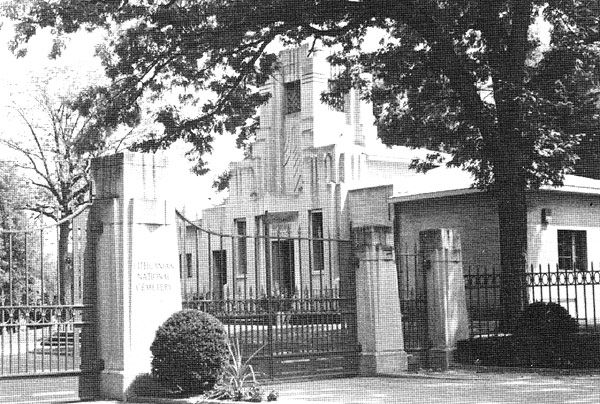
New Office - built in 1937
A Community That Evolved
We came from many paths, but we met in the same ground
Over time, the cemetery continued to evolve alongside the community it served. The foundations laid in the early decades remained, but the meaning and use of the space naturally broadened with each generation.
Following World War II, a new wave of Lithuanian immigrants brought renewed cultural life and diversity of religious practice to the community. As families grew and settled across generations, the cemetery increasingly reflected a wider range of traditions, while still remaining deeply rooted in its Lithuanian heritage.
By the late 20th century, these changes were fully reflected in the life of the cemetery. Practices that had once been shaped by clear boundaries between church-affiliated and community-based burial grounds had gradually given way to a more inclusive understanding of shared heritage and remembrance.
A meaningful expression of this evolution came on June 12, 1995, when Bishop Paulius Baltakis, O.F.M., blessed the wayside cross at the cemetery. His presence marked a moment that would have been unlikely in 1911, and it reflected how relationships between the Lithuanian Catholic Church and community cemeteries had matured over time.
Burial traditions had also changed significantly. What had once been a landscape shaped by separation between church cemeteries and community burial grounds had, over the decades, become more integrated. Reflecting the lived reality of generations of Lithuanian-Americans whose identities and practices evolved in the United States.

Bishop Paulius Baltakis O.F.M blessing the wayside cross gifted by Julius and Pranė Pakalka

Ariel view of the cemetery
A Legacy That Continues
More than a century later, the Lithuanian National Cemetery remains a place of remembrance, heritage, and belonging, while continuing to grow alongside the community it serves.
What began in 1911 as a vision rooted in Lithuanian identity has evolved into a cemetery that welcomes people of all nationalities and religions, who wish to become part of its peaceful and historic grounds. Today, the cemetery continues to offer both traditional burial options and modern services, including green burials and above-ground interment of cremated remains within the granite columbarium.
As the cemetery enters its second century, ongoing care and preservation remain an important part of its future. Continued improvements to the grounds, including road paving, fence restoration, landscaping, and long-term maintenance help ensure that the cemetery remains a beautiful and respectful place for generations to come.
More than one hundred years old, the cemetery carries not only history, but also the responsibility of preserving that history. The continued support of families, visitors, and the broader community plays an important role in sustaining and protecting this shared heritage.
We do not only preserve history here - we continue it!

Families and our grounds crew work together to keep our cemetery beautiful

Two visitors stop to read about Al Carter - a man of many firsts
